

Does The Genetic Makeup Of A Species Change
/https://tf-cmsv2-smithsonianmag-media.s3.amazonaws.com/filer/ce/91/ce9123c1-79e5-430a-a6c6-3d01c65aca7c/darwins_finches_by_gould.jpg)
For Charles Darwin, "species" was an undefinable term, "one arbitrarily given for the sake of convenience to a set of individuals closely resembling each other." That hasn't stopped scientists in the 150 years since then from trying, however. When scientists today sit downwardly to study a new form of life, they employ whatsoever number of more than than 70 definitions of what constitutes a species—and each helps get at a different aspect of what makes organisms distinct.
In a mode, this plethora of definitions helps testify Darwin'south point: The idea of a species is ultimately a human construct. With advancing Deoxyribonucleic acid technology, scientists are now able to draw finer and finer lines between what they consider species by looking at the genetic code that defines them. How scientists cull to draw that line depends on whether their subject field is an animal or found; the tools available; and the scientist'south own preference and expertise.
Now, every bit new species are discovered and old ones thrown out, researchers want to know: How do nosotros define a species today? Let's wait dorsum at the evolution of the concept and how far it's come.
Peradventure the most archetype definition is a grouping of organisms that can brood with each other to produce fertile offspring, an idea originally set up forth in 1942 past evolutionary biologist Ernst Mayr. While elegant in its simplicity, this concept has since come nether fire past biologists, who argue that it didn't apply to many organisms, such every bit unmarried-celled ones that reproduce asexually, or those that have been shown to breed with other distinct organisms to create hybrids.
Alternatives arose speedily. Some biologists championed an ecological definition that assigned species according to the environmental niches they fill (this brute recycles soil nutrients, this predator keeps insects in cheque). Others asserted that a species was a set up of organisms with physical characteristics that were distinct from others (the peacock'southward fanned tail, the beaks of Darwin's finches).
The discovery of DNA'due south double helix prompted the creation of yet another definition, i in which scientists could look for minute genetic differences and depict fifty-fifty finer lines cogent species. Based on a 1980 book by biologists Niles Eldredge and Joel Cracraft, nether the definition of a phylogenetic species, creature species at present tin differ by just 2 percent of their Deoxyribonucleic acid to exist considered separate.
"Back in 1996, the world recognized one-half the number of species of lemur in that location are today," says Craig Hilton-Taylor, who manages the International Spousal relationship for the Conservation of Nature's Red List of threatened species. (Today in that location are more than 100 recognized lemur species.) Advances in genetic applied science have given the arrangement a much more than detailed picture of the world's species and their wellness.
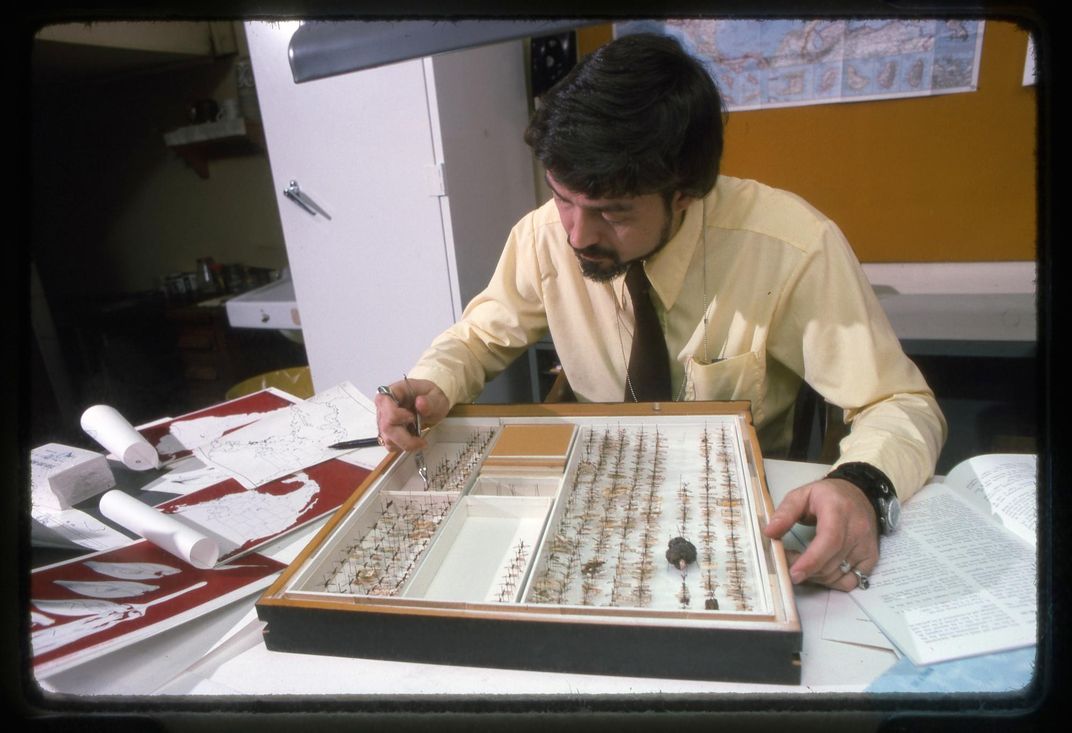
These advances have also renewed debates about what it means to be a species, equally ecologists and conservationists discover that many species that once appeared singular are actually multitudes. Smithsonian entomologist John Burns has used DNA technology to distinguish a number of and then-called "ambiguous species"—organisms that appear physically identical to a members of a certain species, but accept significantly unlike genomes. In a 2004 study, he was able to determine that a species of tropical butterfly identified in 1775 actually encompassed 10 split up species.
In 2010, advanced DNA technology immune scientists to solve an age-old debate over African elephants. Past sequencing the rarer and more than circuitous DNA from the nuclei of elephant cells, instead of the more commonly used mitochondrial DNA, they determined that African elephants actually comprised two separate species that diverged millions of years ago.
"You can no more phone call African elephants the same species as you can Asian elephants and the mammoth," David Reich, a population geneticist and atomic number 82 author on the study, told Nature News.
In the wake of these and other paradigm-shifting discoveries, Mayr's original concept is rapidly falling apart. Those two species of African elephants, for example, kept interbreeding as recently as 500,000 years ago. Another example falls closer to domicile: Recent analyses of Dna remnants in the genes of modern humans accept found that humans and Neanderthals—unremarkably thought of as separate species that diverged roughly 700,000 years ago—interbred as recently equally 100,000 years ago.
So are these elephants and hominids still separate species?
This isn't just an argument of scientific semantics. Pinpointing an organism's species is critical for any efforts to protect that beast, particularly when information technology comes to regime action. A species that gets listed on the U.S. Endangered Species Human action, for case, gains protection from whatsoever destructive deportment from the regime and private citizens.These protections would be impossible to enforce without the ability to determine which organisms are part of that endangered species.
At the same time, advances in sequencing techniques and engineering are helping today'southward scientists amend piece together exactly which species are being impacted by which human actions.
"We're capable of recognizing virtually whatsoever species [now]," says Mary Curtis, a wildlife forensic scientist who leads the genetics team at the U.S. Fish and Wildlife Service's Forensics Laboratory. Her lab is responsible for identifying any animal remains or products that are suspected to accept been illegally traded or harvested. Since adopting DNA sequencing techniques more than 20 years ago, the lab has been able to brand identifications much more than chop-chop, and increase the number of species it can reliably recognize by the hundreds.
"A lot of the stuff we get in in genetics has no shape or form," Curtis says. The lab receives slabs of unidentified meat, crafted decorative items or even the stomach contents of other animals. Identifying these unusual items is usually out of the reach of taxonomic experts using body shape, pilus identification and other physical characteristics. "We tin only practice that with Deoxyribonucleic acid," Curtis says.
Still, Curtis, who previously studied fishes, doesn't discount the importance of traditional taxonomists. "A lot of the time we're working together," she says. Experienced taxonomists can oftentimes rapidly identify recognizable cases, leaving the more expensive DNA sequencing for the situations that really need it.
Not all ecologists are sold on these advances. Some limited concerns near "taxonomic inflation," as the number of species identified or reclassified continues to skyrocket. They worry that as scientists draw lines based on the narrow shades of deviation that Deoxyribonucleic acid engineering enables them to see, the entire concept of a species is being diluted.
"Not everything you tin distinguish should be its ain species," as German zoologist Andreas Wilting told the Washington Post in 2015. Wilting had proposed condensing tigers into simply ii subspecies, from the electric current nine.
Other scientists are concerned about the furnishings that reclassifying once-singled-out species can have on conservation efforts. In 1973, the endangered dusky seaside sparrow, a minor bird one time found in Florida, missed out on potentially helpful conservation assistance by beingness reclassified as a subspecies of the much more populous seaside sparrow . Less than two decades afterwards, the dusky seaside sparrow was extinct.
Hilton-Taylor isn't sure yet when or how the ecological and conservation communities will settle on the idea of a species. But he does expect that Dna technology will have a significant touch on on disrupting and reshaping the work of those fields. "Lots of things are changing," Hilton-Taylor says. "That'due south the world we're living in."
This incertitude is in many ways reflective of the definition of species today also, Hilton-Taylor says. The IUCN draws on the expertise of various different groups and scientists to compile information for its Cherry List, and some of those groups have embraced broader or narrower concepts of what makes a species, with differing reliance on DNA. "There'south such a diversity of scientists out there," Hilton-Taylor says. "We just have to go with what we have."
Source: https://www.smithsonianmag.com/science-nature/what-does-it-mean-be-species-genetics-changing-answer-180963380/
Posted by: dickersonrore1943.blogspot.com
0 Response to "Does The Genetic Makeup Of A Species Change"
Post a Comment